Living in the question

'. . . the point is, to live everything. Live the questions now. Perhaps you will then gradually, without noticing it, live along some distant day into the answer.' RAINER MARIA RILKE Letters to a Young Poet

Showing posts with label poetry. Show all posts

Sunday, 14 October 2012

Does Poetry Matter?


Artistic Afternoons: "Poetry is the language of the spirit and the soul, not of the discursive mind. It compresses the lived truth of the poet's experience into a beauty and wisdom that can slip under the skin of the reader and enter the bloodstream." - For Lovers of God Everywhere
 
 
Roald Dahl's "I've Eaten so Many Strange and Scrumptious Dishes. . ." from James and the Giant Peach.


 Address - Sunday 14th October.
Most of you know that I love poetry.  Unfortunately this is something that is not shared by everyone.  Many people have developed as much a fear of poetry as they have of my other love, mathematics, and in a way I guess that it is for much the same reason.  That somewhere in the past a combination of bad teaching and a sense of failure have struck a fear in the heart when we hear the word mathematicss and similarly when we are asked to read a poem.  Despite this though I am sure that for everyone here there is a sense of the poetic somewhere within you.  It might be that a snippet of verse or even a complete poem may have crept into your mind and whenever you hear that familiar line or verse you mentally join in with it.  It may be the poems of your childhood, poems that can contain such wonderful words and pictures that you might never find anywhere else except in a poem.  The poem by Roald Dahl is an example of some of those wonderful words – such as dandyprats, mudburgers and stinkbugs – the pictures they conjure up must surely fire the imagination of today’s children.   
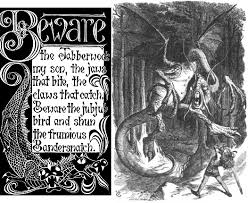
For me it was the poetry of Lewis Carroll – such as Jaberwocky  and ‘ ‘twas brillig and the slithy toves  did gyre and gimble in the wabe;/all mimsy were the borogroves, /and the mome raths outgrabe . . .  


That to me is the wonder of all poetry – the words. . .
Arthur Mampel said: “The poet and man of letters, Archibald MacLeish tells in one of his poems how difficult it is for the poet to communicate reality with words. It is like awakening from a marvellous dream where everything is clear and crystal like—and then, when our eyes are opened, the memory of the dream becomes fuzzy and out of focus and confused.”
I would like you to hear that poem by MacLeish:

Words In Time

Bewildered with the broken tongue
of wakened angels in our sleep
then lost the music that was sung
and lost the light time cannot keep!

There is a moment when we lie
Bewildered, wakened out of sleep,
when light and sound and all reply:
that moment time must tame and keep.

That moment like a flight of birds
flung from the branches where they sleep,
the poet with a beat of words
flings into time for time to keep.
—(Poet’s Choice page 20-21, eds. Engle & Langland)


“The Preacher of words,” says Mampel, “the Teller of tales, the Weaver of words, the Journalist, the Poet—they all face and share the same dilemma. How do you convey reality to people by the use of mere words?
I think that poetry may be the one medium in print today that still communicates life through words.”

The words of poetry can go on to speak to us of all the subjects that affect us during our lives and in a way that helps us to express all our emotions. 


In 2009 the BBC produced a series of four programmes entitled ‘My Life in Verse’ where four celebrities were asked to share the poems they found moved them or were important in their lives.


 I remember the episode when Sheila Hancock shared her favourite poems which expressed her life and love for her husband the actor John Thaw of Sweeney and 
Morse fame.  

 

She chose love poems including the famous sonnet by Elizabeth Barrett Browning  which begins -

How do I love thee? Let me count the ways,
I love thee to the depth and breadth and height
My soul can reach. . . .

  And George Herbert’s poem – Love

Love bade me welcome, yet my soul drew back,
Guilty of dust and sin.
But quick-eyed Love, observing me grow slack
From my first entrance in,
Drew nearer to me, sweetly questioning
If I lack’d anything.

And then moving on to the time of grief after his death with the Auden poem –

 Stop all the clocks, cut off the telephone,
Prevent the dog from barking with a juicy bone,
Silence the pianos and with muffled drum
Bring out the coffin, let the mourners come

 And the sonnet by Edna St Vincent Millay

TIME does not bring relief; you all have lied
    Who told me time would ease me of my pain!
    I miss him in the weeping of the rain;
I want him at the shrinking of the tide;
The old snows melt from every mountain-side,
    And last year’s leaves are smoke in every lane;
    But last year’s bitter loving must remain
Heaped on my heart, and my old thoughts abide!


There are a hundred places where I fear
    To go,—so with his memory they brim!
And entering with relief some quiet place
Where never fell his foot or shone his face
I say, “There is no memory of him here!”
    And so stand stricken, so remembering him!


The emotions expressed in these poems cannot be denied and I cannot read them without feeling like shedding a tear.
Poetry helps us to express our emotions, whether of joy or sadness, in a unique way.  Sometimes poems can be used to express our feelings when normal conversation just doesn’t work.
Kathleen O’Dwyer says:
“Even with those whom we love it is not always possible to be completely honest. From Homer to Shakespeare, from Bob Dylan to Seamus Heaney, and from the poetic word reverberating in each person’s life, we receive glimpses of reality and of experience that cannot be articulated in other forms.
We need the truth, the courage and the honesty of poetry to keep us real, to keep us connected with what really matters and to continually lift the veil of familiarity and camouflage which disguises and distorts our understanding of the human condition.
Poetry matters because it combines beauty and truth, pain and joy, hope and despair. It accepts the poignancy of the human condition while it celebrates its resilience and potentialities; it rejoices in the fact that we are “human, all too human” and that, in the words of Leonard Cohen, “there is a crack in everything, that’s how the light gets in.” Poetry answers to a universal human need to go beyond conventional modes of thought and expression, and it continually opens us to new possibilities and new ways of being.”
A poem is a tightly woven and highly compressed pattern of images, emotions, perceptions, and experiences.
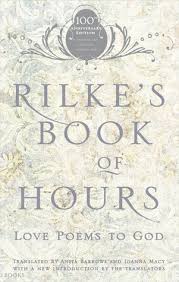
For me though the poetry that speaks to me most powerfully now, is the poetry that speaks about God, or the Divine; that which is often called spiritual poetry.  My most well read book of these poems are contained in this book 


– Rilke’s Book of Hours – Love poems to God and I could probably just open it to any page and read but I have chosen an excerpt from one poem – it is one that speaks of poetry.

And you inherit the green
of vanished gardens
and the motionless blue of fallen skies,
dew of a thousand dawns, countless summers
the suns sang, and springtimes to break your heart
like a young woman’s letters.

You inherit the autumns, folded like festive clothing
in the memories of poets, and all the winters,
like abandoned fields, bequeath you their quietness.
You inherit Venice, Kazan, and Rome;

Florence will be yours, and Pisa’s cathedral,
Moscow with bells like memories,
and the Troiska convent, and that monastery
whose maze of tunnels lies swallowed under Kiev’s gardens.

Sound will be yours, of sting and brass and reed,
and sometimes the song will seem
to come from inside you.

For your sake poets sequester themselves,
gather images to churn the mind,
journey forth ripening with metaphor,
and all their lives they are so alone…
And painters paint their pictures only
that the world, so transient as you made it,
can be given back to you,
to last forever.

All becomes eternal. . . .
Rainer Maria Rilke

And the other poet whose works I am reading at the moment T.S Elliot ends his work – The Four Quartets with these words; words that describe words:

What we call the beginning is often the end
And to make an end is to make a beginning.
The end is where we start from. And every phrase
And sentence that is right (where every word is at home,
Taking its place to support the others,
The word neither diffident nor ostentatious,
An easy commerce of the old and the new,
The common word exact without vulgarity,
The formal word precise but not pedantic,
The complete consort dancing together)
Every phrase and every sentence is an end and a beginning,
Every poem an epitaph.

We shall not cease from exploration
And the end of all our exploring
Will be to arrive where we started
And know the place for the first time.

The most important thing about poetry is that it is read and read often.  It is no good having poetry books on our shelves if they are not picked up and read. If we love poetry, we will read it and re-read it, think about - often, and browse in books of poetry: our attention will will then 'fill out and make radiant this life of ours.'
Yes: our attention will will then 'fill out and make radiant this life of ours.'
 
So May it Be.     Amen          
 

Sunday, 17 June 2012

Song of Myself


This is an address on Walt Whitman and why I love his poetry.

Walt Whitman

Last week the poet Michael Rosen wrote this comment:
“I'm probably jumping the gun a bit here, but the press is full this weekend with accounts of what is anticipated to appear in the new guidelines for Primary English.
What seems to be coming up is a requirement that all primary children from the age of 5 should learn poetry by heart.
”
From the discussions that have been on the radio and television this week Michael Rosen was correct, as part of his Curriculum reform Michael Gove is suggesting that all infant and primary aged children should be expected to learn and recite poetry along with times tables and other facts.
Now as an ex teacher I can see the value of learning things by rote and that includes poetry, but when it comes to poetry I am a little unsure as to how it will affect children’s future attitudes if it is not handled properly.  I am sure there are those of us here who can remember being made to learn verses by heart when we were at school.
I certainly can, and I never did find it easy.  Times tables I could manage but poetry – well I never did manage to commit any to memory. 
Did any of you?
And I wonder how many of you actually read poetry now today and if you do was it because of this learning experience?
As this news played out I began to think about where my love of poetry came from – because as most of you are aware I do love poetry.
Well it didn’t begin during my school years at all.  No, I know the exact year when I turned to poetry and began to read it.  It was 1989 and I was 40 years old.  It happened when I went to see a film that was released that year, starring Robin Williams – it was called ‘The Dead Poets Society’.
In it Williams plays the part of one John Keating, a rather different teacher of English, especially poetry.   


One of the most memorable speeches for me was when John Keating says to the boys he is teaching:
‘We don't read and write poetry because it's cute. We read and write poetry because we are members of the human race. And the human race is filled with passion. And medicine, law, business, engineering, these are noble pursuits and necessary to sustain life. But poetry, beauty, romance, love, these are what we stay alive for. To quote from Whitman, "O me! O life!... of the questions of these recurring; of the endless trains of the faithless... of cities filled with the foolish; what good amid these, O me, O life?" Answer. That you are here - that life exists, and identity; that the powerful play goes on and you may contribute a verse. That the powerful play *goes on* and you may contribute a verse. What will your verse be?’

                                       
It was a mixture of those words and the image of Robin Williams striding about saying call me: "O Captain! My Captain!," in reference to a Walt Whitman poem, that set me off reading poetry for the first real time.
Now I must admit I didn’t take to Walt Whitman’s poetry then, it was, I think, far too American and I didn’t really understand it.
It took me finding the Unitarian church, a decade or so later, to begin to appreciate Whitman.  Not that he was a Unitarian, no he was a Quaker if anything but he has even been called an atheist.  However he did move in Unitarian circles and was friends with people such as Ralph Waldo Emerson and Henry David Thoreau.

‘And the Transcendentalist movement, to which Whitman belonged, was firmly rooted in the Unitarian tradition.
And then, of course, there is his tangential association with Bolton Bank Street chapel, which has connections with a local Whitman society, which has been in existence, on and off, for over a century. In 1887 two Bolton men, J.W. Wallace and Dr. John Johnston, sent birthday greetings to Walt, and to their great surprise and delight, he responded, and a regular correspondence – over one hundred letters – ensued, until the poet’s death five years later. Now, on the nearest Saturday to Walt’s birthday, 31st May, there’s an annual Whitman walk, in which participants wear sprigs of lilac, Walt’s favourite flower, and make frequent stops to read from Leaves of Grass and to drink from a ‘loving cup’. On the Sunday following there is a service in Bank Street Chapel, to commemorate the Whitman Society’s association with the Unitarian movement.  
                                                                                                                            
   What is it in Whitman’s poetry that was so appealing to the Unitarians of 19th century Lancashire and to contemporary Unitarians worldwide? One reason is his independent, almost revolutionary, spirit. His poetry, in both style and content, is radically new. His verse is free, direct, accessible, untrammelled by conventional decorative features such as rhyme and rhythm. Emerson recognised that Whitman’s was the first authentically American poetic voice. Before him, American writers, including Emerson himself, had copied European models, but Walt struck out on his own. ‘Resist much, obey little,’ his words of advice to the American states, could be taken as the motto of his own life and his own work.’ (Bill Darlison)


Walt Whitman is not an easy read, his poetry is full of uncomfortable things and a lot of it was not allowed in print at first because it is sexually explicit.  Also his poems are extremely long and I certainly wouldn’t recommend trying to read them whole but maybe try dipping in and you find such wonderful delights as:

A noiseless patient spider,
I mark’d where on a little promontory it stood isolated,
Mark’d how to explore the vacant vast surrounding,
It launch’d forth filament, filament, filament, out of itself,
Ever unreeling them, ever tirelessly speeding them.

And you O my soul where you stand,
Surrounded, detached, in measureless oceans of space,
Ceaselessly musing, venturing, throwing, seeking the spheres to connect them,
Till the bridge you will need be form’d, till the ductile anchor hold,
Till the gossamer thread you fling catch somewhere, O my soul.

And it is verses such as that second one that call out to me now as they speak of the soul.  How Whitman can be called an atheist I do not know for his poems are full of the soul.
Audrey Addison Williams  says: “My prayer for all of humanity is that we learn to live from a place of "soul". In my work, I am stunned by the number of people who have no idea about the longings of their heart and soul. They live like robots, doing almost mechanically what they feel they must do. Than we spend billions on medicine and doctors trying to figure out why we are in so much pain. Today, listen to your heart, connect with your soul. Your soul has all the wisdom you shall ever need. “


Whitman’s most famous poem, that I read from in our reading is the ‘Song of myself’ and it is full of words of wisdom that speak of life, of love and for me of God.

Those words at the end of that verse I read:
“I hear and behold God in every object, yet understand God not in the least,
Nor do I understand who there can be more wonderful than myself.
Why should I wish to see God better than this day?
I see something of God each hour of the twenty-four, and each moment then,
In the faces of men and women I see God, and in my own face in the glass,
I find letters from God dropt in the street, and every one is sign'd
    by God's name,
And I leave them where they are, for I know that wheresoe'er I go,
Others will punctually come for ever and ever.”
 
Others will punctually come for ever and ever.
 
These words sum up my whole theology. His God is probably not the God of Christianity, but Whitman’s poetry is drenched in what we might call God-consciousness. As the Rev Bill Darlison says:
 
This may be pantheism, deism, panentheism, it may even to some be considered blasphemous, but it is certainly not atheism. Whitman has no belief in a static revelation; the genius behind all the great religions is the inexhaustible genius of the human race which is as active now as ever it has been. He doesn’t object to special revelations, but, he says he considers ‘a curl of smoke or the back of my hand just as curious as any revelation.’[Song of Myself] The simplest creature is a manifestation of God, a miracle, a revelation:

I believe a leaf of grass is no less than the journey work of the stars...
And the narrowest hinge of my hand puts to scorn all machinery.....
And a mouse is miracle enough to stagger sextillions of infidels.

Walt Whitman’s poetry gives you a recipe for living.  He tells you first and foremost to be yourself and in the words of Robin Williams, as the teacher John Keating he says in no uncertain terms that Latin phrase ‘Carpe Deum’  which means ‘seize the day’
Seize the day.

Just opening my book of Whitman’s poems at random the poem I found was this:


DAREST thou now, O Soul,

Walk out with me toward the Unknown Region,

Where neither ground is for the feet, nor any path to follow?


2

No map, there, nor guide,

Nor voice sounding, nor touch of human hand,
Nor face with blooming flesh, nor lips, nor eyes, are in that land.


3

I know it not, O Soul;

Nor dost thou—all is a blank before us;

All waits, undream’d of, in that region—that inaccessible land.


4

Till, when the ties loosen,
All but the ties eternal, Time and Space,

Nor darkness, gravitation, sense, nor any bounds, bound us.


5

Then we burst forth—we float,

In Time and Space, O Soul—prepared for them;

Equal, equipt at last—(O joy! O fruit of all!) them to fulfil, O Soul.

I could go on - there are so many poems that cry out to be read.  But do I read them because I was made to learn poems by heart as a young child?  No I read them because as an adult I have come to poetry myself.  I have travelled in my own way just as Walt would have wanted me to because as he said:
“ No one is going to do the hard work for you, you must find the meaning of your life & your destiny yourself.”
And so it must be for our children too.
So May it be
    Amen