Living in the question

'. . . the point is, to live everything. Live the questions now. Perhaps you will then gradually, without noticing it, live along some distant day into the answer.' RAINER MARIA RILKE Letters to a Young Poet

Showing posts with label Rainer Maria Rilke. Show all posts

Thursday, 27 March 2014

Can art be a spiritual pastime?

Can art be a spiritual pastime - that really is the question that has been uppermost in my thoughts over the past months and is the question I appear to be living right now?

I have not written on this blog for some time, indeed since I retired from my ministry at Rochdale Unitarian Church at the end of September 2013.  In the last six months I have been trying to find an identity for myself and a vehicle for developing the spiritual side of my daily life.  It all changes when you leave the practice of ministry; when you no longer have the weekly pull of the pulpit to direct your attention.  In ministry I was engaged, in some way, in my connection with the divine for the larger part of my day.  I would say that as much as 90% of my waking life was taken up with this connection and suddenly away from active ministry I find myself adrift, cut off and rudderless.  I have to engage spiritually intentionally far more than ever before.

One of the ways in which I have begun to occupy my days is with the act of being creative.  I am exploring different artistic disciplines in a variety of creative pursuits.  It is a tentative process and I am discovering many new things about myself in the process.

For the last few years my main creative love has been quilting and the last few months have seen an increased production of quilts and quilted objects as I have gloried in the increased time to indulge this passion. 


 Quilting has always had a spiritual element for me as when I am engaged in the process then I have to be totally engaged, if not I will make mistakes and the piece of work will not satisfy me.  It is when I am engaged mindfully in something that I find my heart opening up as the mind disengages with the external world and a sense of what can only be called prayer is about me.  Because of this I wondered if I would find the same transformative process happening if I engaged in other artistic endeavours and to this end I have turned my hand to painting, particularly in water colour, sketching, doodling and more recently to stitching.

Painting:                                                                     
water colour of archway of Gartmore House 

painted February 2014                                                                                                            
                                                             Sketching:


Sunflower sketch  
done as part of the poememe project

March 2014

 Doodling:


 One of my first doodles

July 2012


Stitched art:

 
First attempt at stitched art work translating the sunflower sketch into a free-motion quilted art piece.

March 2014 


JOHN BERGER said:
“All the languages of art have been developed as an attempt to transform the instantaneous into the permanent. Art supposes that beauty is not an exception - is not, in despite of - but is the basis for an order ... Art is an organized response to what nature allows us to glimpse occasionally ... The transcendental face of art is always a form of prayer.”

And RAINER MARIA RILKE said:
“How other future worlds will ripen to God I do not know, but for us art is the way.”

So it is for me as I find my creative self providing the way to open myself up to that which is God for me.

Kent Nerburn in Letters to My Son says:
"Once you love an art enough that you can be taken up in it, you are able to experience an echo, of the great creative act that mysteriously has given life to us all .

It may be the closest any of us can get to God.”

Julia Cameron, a writer who has written on both art and spirituality. In “Walking in this World”  says:

“I would like to acknowledge the place of grace in the making of art and artists.  It is a great grace that we are born creative beings. It is a great grace that we access that creativity. Although you may language it differently, all creators feel the hand of the great creator touching them through their work.  Art is a spiritual practice. We may not and need not do it perfectly but we do need to do it. And it is my belief that the making of art makes us more fully human and in becoming more fully human we become more fully divine, touching in our finite way the infinite spark within each of us.  Focused on our art we connect the heart-full heart of all life.  The creative pulse that moves through us moves through all creation. It could be argued that all creativity is then a form of prayer, a form of thankfulness and recognition of all we have to be thankful for walking in this world.”


As yet my steps are tentative, my confidence in my ability is not great but it is improving the more I practice; and the spiritual fulfilment is becoming more and more evident in my everyday life.  I find that the sense of walking with the divine is once again a major part of everything I do.  So I am living in that question “Is art a spiritual pastime” and right now I am answering “Yes, yes it is!”


examples of sketch to stitch and doodle to stitch both completed in March 2014 .

Sunday, 29 July 2012

Beauty in Brokenness?


I wonder how many of you spent some time on Friday evening watching the opening ceremony of the Olympics.   


You may not have watched it all – it was a very long evening of viewing – but you may have watched some of it.  It was in all senses of the word a spectacular event.  Danny Boyle – local man from Radcliffe, Bury - certainly did good.  For me it was the music that I found brilliant, especially the use of voices without music - that opening version of Jerusalem sung by a young boy soprano – well it sent shivvers tingling down my spine.  For my colleague Danny Crosby what stood out for him was another simple human voice, right in the middle of the ceremony. It began in the transitional moment just before the parade of the nations. Emeli Sande, sang beautifully and movingly the classic hymn and great sporting anthem “Abide With Me”, accompanied by a dance troop and under a beautiful orange light. This was a tribute to the victims of the London 7/7 terror attacks, which took place the day after Britain had won the 2012 Olympic bid.


As the historical tableau unfolded itself, each scene more and more spectacular than the preceding one I found my mind wandering off into thinking about all those people who are not able to sit in the comfort of a home and watch this event.  Not by choice but by circumstance. It is always the same for me when I find myself watching something grand, or attending some event such as a wedding where people seem to only be able to enjoy themselves by the spending of large amounts of money.  It is the same feeling I get at Christmas when everything is about the material and less about the spiritual. A part of me wants to shout out and ask what about those who haven’t got all this or access to all this affluence.  And I am not thinking about those in other poorer countries but the people here in this country, this town even – in this wonderful England that we saw portrayed so splendidly in that ritual on Friday evening.

A few weeks ago Helen came to me with the song that the choir sang for us this morning.  I took the words home to read and I found a recording on the internet and it was beautiful. Whether performed by Graham Kendrick, who wrote it, accompanied by his acoustic guitar or by a church choir and organ - the song sounded really special.
The first two verses in particular stood out . . .

Beauty for brokenness
Hope for despair
Lord, in your suffering
This is our prayer
Bread for the children
Justice, joy, peace
Sunrise to sunset
Your kingdom increase!

Shelter for fragile lives
Cures for their ills
Work for the craftsman
Trade for their skills
Land for the dispossessed
Rights for the weak
Voices to plead the cause
Of those who can't speak

It has seemed over the last few weeks that these words have taken on more and more meaning.  Particularly as glitches in computer programmes have caused serious errors in banking circles.   The blog by Jill Segger   (http://www.ekklesia.co.uk/node/16780)
highlighted how something like that can be catastrophic for families or individuals who are teetering on the edge of poverty.  I was able to shrug it off the fact that I could not use my cash card for a few days, but what if I wasn’t in a position to do that.  What would I have done or been able to do?  When my card failed as I tried to buy petrol on the way down to Oxford one of my passengers stepped in and saved my day.  But what if there was no one there with me to do that?

Earlier this month at the writing workshop I attend we discussed the question of homelessness.  Two people from the team who work with Petrus – a charity that supports homeless people in Rochdale - spoke to us about their work.  For 40 years Petrus has provided help for those who have slipped out of the system and at the moment they help support 60 or more people in 7 houses and yet it is not enough to meet the demand.  And this service is in danger because of the huge cuts there have been since the present government removed funding saying we should be able to rely on ‘the big society’.  How can we provide ‘shelter for fragile lives’ as more and more people find themselves closer and closer to the brink of poverty as Jill Segger pointed out.

At the writing workshop I was reminded of the Ralph McTell song, ‘The Streets of London’, which he was renowned for in the 70’s.   


I remember it because I went to London to watch Ralph McTell at a recording for ‘In Concert’ in 1974.  I was accompanying a group of children from the school where I was teaching.  As we queued to go in, five of us were selected to sit on the stage for the recording.  So if you ever see a recording of ‘Ralph McTell In Concert’  then there I am sitting in front of a backdrop that shows scenes of the homeless.  I can never hear the song without remembering those larger than life images portrayed on the set.

The Chorus:

So how can you tell me you're lonely
And say for you that the sun don't shine?
Let me take you by the hand and lead you through the streets of London
I'll show you something to make you change your mind

Indicates that the song is really about loneliness and yet the second verse has always remained the most vivid image for me.

Have you seen the old girl
Who walks the streets of London
Dirt in her hair and her clothes in rags?
She's no time for talking
She just keeps right on walking
Carrying her home in two carrier bags

Can you imagine what it might be like to have nothing except what you can carry in these? 


What chance that someone who has so little could have seen that spectacular opening celebration on Friday evening?  More likely they would have been walking the streets looking for somewhere to sleep for the night.  Or, maybe scavenging in bins for scraps of food to eat; or sitting on the street begging for money which in all likelihood would be spent on cheap alcohol in an attempt to block out the desperation of their situation.  No there is not much chance is there, and if they had would they have felt that there was anything worth celebrating?

My favourite poet, Rainer Maria Rilke wrote in his Sonnets to Orpheus II, 19

Gold leads a pampered life, protected by banks,
on intimate terms with the best people.
The homeless beggar is no more than a lost coin
fallen behind the bookcase or in the dustpile under the bed.

In the finest shops, money is right at home,
loving to parade itself in flowers, silk and furs.
He, the silent one, stands outside this display.
Money, near him, stops breathing.

How does his outstretched hand ever close at night?
Fate, each morning, picks it up again,
holds it out there, naked and raw.

In order to grasp what his life is like,
to see it and cherish it, you would need a song,
a song only a god could bear to hear.

I am not sure how I can reconcile all this, or what I can do, if anything, to alleviate some of this poverty, this suffering, this tremendous problem for so many. I do give food to food banks, I do answer pleas from charities such as Petrus as much as I can.  But I think one of the main things I can do is make sure that I notice - and that ‘I see’, that I remember when I am enjoying the luxury of watching the spectacular on the TV that not everyone is as fortunate as you or me.

I can also hold them in my hearts and in my prayers and hope that I can find some beauty in their brokenness; and that I can find a way to put in to action in some way the sentiments of Graham Kendrick’s song
When he says:

God of the poor,
friend of the weak,
give us compassion we pray
melt our cold hearts
let tears fall like rain
Come, change our love
from a spark to a flame

Come, change our love
from a spark to a flame

 So may it be.    Amen       


Sunday, 3 June 2012

A struggle with God


 from a service 3.06.12

I tend to give my services titles as it helps me to focus on the subject.  Today’s is called ‘A struggle with God’ strange you might think as a title for a minister of Religion, but then of course I am a Unitarian so maybe it might not be such a surprise after all that I should speak about struggling with God.  Actually the title came from the story in Genesis 32 where Jacob wrestles with an angel.
                                                         
  In that story it is more a wrestle but for me it is definitely more of a struggle.

I remember when I first became a minister, (is it really almost six years ago?) someone once said to me, Gillian, you mustn’t assume that we know the stories of the Bible we’re Unitarians.  So I suppose I had better give you a bit of background about Jacob so that we all understand why he should be wrestling with God in the first place.

 Jacob was the son of Isaac and Rebecca, the grandson of Abraham and Sarah. So he is a pretty important figure. The whole story of Jacob begins in one of those really, really strange Bible moments. Jacob, God’s chosen leader essentially cheated his older brother out of his birthright of inheritance. Jacob dressed up as his older and simpler brother to trick his father, Isaac, who was on his death bed. With his mother’s help he pretended to be older brother Essau, so that their father would bless him and make him the official heir. And Jacob pulled it off so that he could be the leader God wanted him to be. Not really a very auspicious start for someone so great.

Then, afraid that Esau might kill him for his treachery, Jacob fled the country, fell in love with Rachel at a well, worked for seven years for Rachel’s father so that he could marry her. The father cheated Jacob by sending in his other daughter Leah, disguised, so that Jacob was married to her. So Jacob worked seven more years until he could marry the sister he first fell in love with.  You might think that this would mean that Jacob’s life is sorted, but no. As we all know there is a saying ‘cheats never prosper’ and so it is in this story. Eventually the cheating caught up with Jacob.    He decided that he must return home,   so he set  off; with two wives, eleven children, the servants and all his belongings—

Then he heard that his brother Esau was coming toward them, accompanied by an army of about 400 men. Jacob panicked —it must be payback time; his brother must still hate him. So Jacob sent his servants ahead with an army of gifts, hoping to buy his brother’s goodwill. And then he sent his family and his flocks of sheep across the river at a river crossing one night. Then he came back across, all alone to get his possessions. While he was there, a mysterious being appeared. Some say it was a man, some say an angel. The two of them wrestled until daybreak.
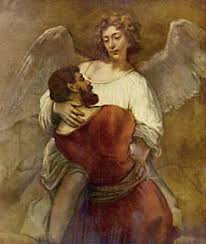
                          Rembrandt - Jacob wrestling with the angel


 When the man saw that he could not overpower Jacob, he touched the socket of his hip so that the hip was wrenched terribly. Then the man said, "Let me go, for it is daybreak. But Jacob replied, "I will not let you go unless you bless me." The man asked him, "What is your name?"
" Jacob," he answered.
Then the man said, "Your name will no longer be Jacob, but Israel, because you have struggled with God and with men and have overcome."

This story is often used to illustrate the moment of a personal struggle with faith. It’s quite literally, if you read the story that way, a moment of wrestling with divinity. It’s a hard fight. Jacob walks with a limp for the rest of his life from where the angel injured his hip. But Jacob struggled with divinity and he refused to let go of that struggle until he got a blessing out of it.

In our lives we all of us have times of struggle, times when we have to wrestle with demons.  No one is exempt.  And when it comes to faith that can be a struggle too.  I envy the person who has such a belief that they have not had to struggle with it, or do I?  Maybe the struggle is worth it, maybe the struggle makes faith stronger.   One person who epitomises this for me is C S Lewis.  Probably best known for his children’s book The Lion, the witch and the wardrobe and the rest of that series and  less well known for his science fiction and for his religious writings.  All of his books though, whichever genre, are about faith, belief and religion.  It is then hard to think  that he was once an atheist.  His autobiography Surprised by Joy tells the story of how he moved from atheism to one of such strength of faith that all his writings speak to it.  In that book he says:

You must picture me alone in that room at Magdalen, night after night, feeling, whenever my mind lifted even for a second from my work, the steady, unrelenting approach of Him whom I so earnest­ly desired not to meet. That which I greatly feared had at last come upon me. In the Trinity Term of 1929 I gave in, and admitted that God was God, and knelt and prayed: perhaps, that night, the most dejected and reluctant convert in all England.

Like Jacob, he had gone through his wrestling match with God.  Rainer Maria Rilke, my favourite poet, puts it into better words than I could in his Book of Hours

It starts with a dream
Add faith, and it becomes a belief.
Add action, and it becomes a part of life.
Add perseverance, and it becomes a goal in sight.
Add patience and time, and it ends with a dream come true.
In deep nights I dig for you like treasure.
For all I have seen
that clutters the surface of my world
is poor and paltry substitute
for the beauty of you
that has not happened yet....

My hands are bloody from digging.
I lift them, hold them open in the wind,
so they can branch like a tree.

Reaching, these hands would pull you out of the sky
as if you had shattered there,
dashed yourself to pieces in some wild impatience.

What is this I feel falling now,
falling on this parched earth,
softly,
like a spring rain?


~ Strange, how this too speaks of dreams, and struggle.  This particular poem always reminds me of the struggle I underwent in finding my faith.  I grew up being involved with the Anglican Church, attending Sunday School and being confirmed and yet by the time I left home to go to college I found that I had no true sense of faith at all.  I fell out of the church and church life and explored many paths.  Over 30 years of exploration I was, I felt, certainly agnostic if not atheist.  Nothing seemed right or true.  Then about fifteen years ago, something happened which was to change my life completely.  I had my own personal struggle with God.  

 Over many years I had suffered with a recurring nightmare.  It began when I was a child and would always rear up when I was feeling vulnerable, or in turmoil.  So times like exams at school.  Leaving home to go to college.  When I got married.  When I got divorced. . . . . .  With alarming regularity the awful dreams would return.   
Then I went to stay with a lovely lady called Amy, she was in her nineties and for various reasons I ended up staying in her house for a month when she had a serious fall and needed nursing if she was to stay in her home.  It coincided with my summer holidays when I was teaching so I stayed.  I was in one of those times of turmoil and was experiencing that dreadful nightmare almost every night.  Amy belonged to a religious group that believed in having an altar in her bedroom.  
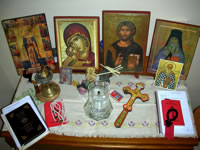
                                                 

 We never talked about it, that was not Amy’s way but I was aware of the existence of this sacred place in her room.  Then one night, the dream happened again and I found myself terrified, literally.  I woke to find myself trying to scream, and the scream was so bad that it was a silent scream.  I was so scared that no sound would come out.  As I lay there in this strange house, with only a frail, elderly woman for company I wondered where my life was going and how I was going to overcome these nightly terrors.  It was then, when I felt at my lowest that I found in my head a vision of Amy’s altar on the other side of the wall and gradually my breathing settled and suddenly I found myself crying, ‘ok, ok, I give in’ and then I admitted to myself, reluctantly, that I did really believe in God.  

 It was another couple of years before I finally found the Unitarian Church in Padiham and I set my feet on the path towards Unitarianism and eventually into Ministry, but it was that night when It all began and everything changed.  And touch wood – I have not had that nightmare again.  It was my Jacob moment.  I had wrestled all night and in the morning I felt blessed by God.
There is a beloved passage from the poet Rilke:
You have had many and great sadnesses, which passed... But, please, consider whether these…sadnesses have not rather gone right through the center of yourself? Whether much in you has not altered, whether you have not somewhere, at some point of your being, undergone a change while you were sad? …Were it possible for us to see further than our own knowledge reaches, and yet a little way beyond the outworks of our divining, perhaps we would endure our sadnesses with [even] greater confidence than our joys. For they are the moments when something new has entered into us, something unknown; our feelings grow mute in shy perplexity…a stillness comes, and the new, which no one knows, stands in the midst of it and is silent.

Something new has entered into us’ – said Rilke, and yes something new had entered into me and continues to enter in, daily.

We all, I am sure, have had our moments of struggle with God on a greater or lesser level; and our human struggle with God is never easy.  Yet within that struggle we experience divine blessing. 
There is a poem by William Stafford called "The Way It Is." It offers wise advice for wrestling with God:
There's a thread you follow. It goes among
things that change. But it doesn't change.
People wonder about what you are pursuing.
You have to explain about the thread.
But it is hard for others to see.
While you hold it you can't get lost.
Tragedies happen; people get hurt
or die; and you suffer and get old.
Nothing you do can stop time's unfolding.
You don't ever let go of the thread.

Jacob's struggle reminds us of that thread: we may struggle with God through the night, but by daybreak there is only the blessing.
May God’s blessing be with us all.
So may it be.